
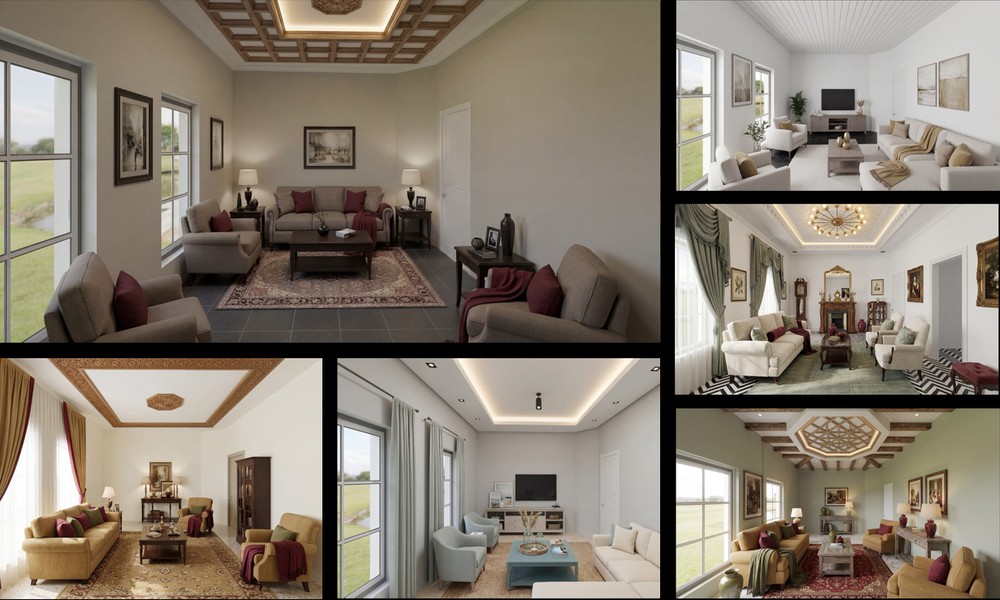
Walk into a well‑designed home and you feel it before you analyse it.
Nothing screams for attention.
Nothing feels flat.
There is a quiet rhythm to the space.
One of the simplest reasons is the 3‑5‑7 rule in interior design.
Designers use this rule to group elements in odd numbers: Three, five, or seven, to create balance, movement, and visual interest. Odd groupings feel more natural to the eye than rigid, even pairs, so rooms look curated but still lived‑in.
Now, something interesting is happening.
Tools like Foursite by VirtualSpaces take this classic rule and plug it into a new kind of workflow.
A workflow where 2D floor plans and Blueprints turn into rich 3D Visualization in minutes, and where AI interior design helps you test ideas at a scale that was impossible a few years ago.
The 3‑5‑7 rule, made simple
At its core, the 3‑5‑7 rule is easy to understand:
- Three anchors: the big moves that define a room, like a sofa, rug, and hero artwork.
- Five supporting elements: accent chairs, a coffee table, a floor lamp, a sideboard, or a feature wall.
- Seven details: smaller pieces that bring personality, such as plants, books, candles, and personal objects.
You can apply this to shelves, sofas, gallery walls, even how you layer materials and colors across a home. The rule is not rigid math.
It is a simple way to keep rooms from feeling either empty or cluttered.
In residential real estate, this matters.
Clients do not speak in design jargon.
But they know immediately when something “feels right“.
The 3‑5‑7 rule gives designers a structure that consistently delivers that feeling, whether they are working on compact apartments or larger family homes.
From 2D to 3D: letting floor plans come alive
For years, this kind of thinking lived mostly in a designer’s head.
The tools lagged behind.
A client would send floor plans as PDFs or images.
Someone would redraw them.
Someone else would build a 3D model.
Then a visualiser would produce interior design renders days later.
Foursite changes that starting point. Designers upload 2D floor plans or Blueprints.
The platform converts them from 2D to 3D using an automated pipeline.
In minutes, you move from blueprint to 3D and floor plan to 3D, without juggling multiple tools.
That simple shift of converting floor plan to 3D and convert blueprint to 3D in one place, means the real design work can start much earlier.
You stand inside a believable 3D Visualization of the home, not a flat drawing.
You can see how the 3‑5‑7 rule might play out in the actual space, not just on a mood board.
How AI interior design amplifies 3‑5‑7
Once the space is in 3D, AI starts to matter.
Foursite uses AI interior design and AI interior décor to generate full-room schemes on top of the real geometry. You pick three anchor moves.
The system suggests five supporting gestures and a set of seven details that still feel coherent with the story of the room.
AI visualization and AI 3D visualization then let you see these options from different angles and at different times of day.
You are not locked into one “final” render.
You can treat interior design 3D visualization as a playground.
This is where Virtual Staging and AI virtual staging evolve.
Instead of staging just for listing photos, designers can use similar capabilities during the design process itself.
You can test different layouts, styles, and 3‑5‑7 groupings before a single piece of furniture is ordered.
For clients, that makes decisions less abstract.
They see how a particular “three” of sofa, rug, and artwork anchors the living room.
They see how five supporting elements adjust the mood.
They see how seven small details change the feel from calm minimal to warm and layered.
Fewer hand‑offs, faster decisions, better margins
There is also a very practical side to this.
Traditional workflows rely on many tools and external vendors.
Each hand‑off costs time and money.
Each revision hurts margins.
By keeping Blueprints, 2D floor plans, floor plans, 3D Visualization, AI interior design, AI interior decor, and interior design renders in one pipeline, Foursite reduces that friction. You spend less time cleaning files and more time refining ideas.
You need fewer outsourced photoreal images because the same engine that powers AI virtual staging can also deliver interior design photoreal renders when needed.
For residential designers and studios, this shows up directly in the business.
Shorter sales cycles.
Lower outsourcing costs.
More projects handled in parallel.
The 3‑5‑7 rule becomes more than a styling trick.
It becomes a repeatable pattern that AI can help you explore quickly, while you stay in control of taste and strategy.
A new operating system for real homes
The most exciting part of this shift is not the technology itself.
It is what it unlocks for everyday homes.
When you can go from 2D to 3D in minutes, use AI interior décor and AI Visualization to explore multiple options, and lean on the 3‑5‑7 rule to keep things coherent, you change who gets access to good design.
You make it easier for a young family to “see” their future living room before they commit.
You make it easier for designers to bring their best thinking to more people.
That is the quiet promise behind platforms like Foursite and VirtualSpaces.
Blueprints stop being static documents.
They become living canvases.
And the simple 3‑5‑7 rule, paired with AI, becomes one of the most powerful tools we have for turning floor plans into homes that actually feel like home.