
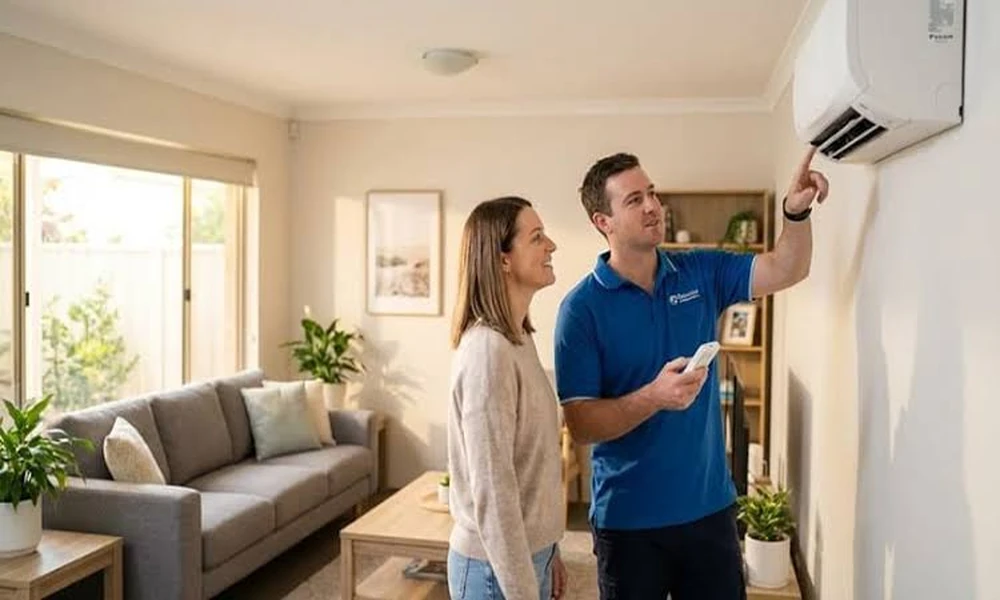
Ask most Perth homeowners when they last had their air conditioning professionally serviced and the answers range from “last year” to “when we had a problem with it” to “I think it came with the house.” The last of these is not as rare as it should be.
Professional air conditioning servicing is the single most consistently undervalued maintenance activity in the average Perth household. The system runs, the house stays cool, and the case for spending money on servicing something that appears to be working seems hard to make. Until the system fails on the first 40-degree day of summer, or the electricity bill for October arrives and turns out to be substantially higher than it should be, or the quote for a compressor replacement arrives and makes a year of servicing fees look like a very modest investment.
This guide establishes a practical service schedule for Perth residential air conditioning, explains what each service visit should cover, and addresses the specific reasons why Perth’s climate demands a slightly different approach to air conditioning maintenance than applies in milder cities.
Why Perth Demands More Attentive Air Conditioning Maintenance
Perth’s air conditioning maintenance requirements differ from those in more temperate Australian cities for several interconnected reasons.
Longer operating seasons. A Perth residential air conditioning system runs for roughly seven months of the year in meaningful cooling mode, with additional heating operation through the mild winter. This is a significantly longer annual operating period than systems in Melbourne or Canberra experience. Longer operating hours mean faster accumulation of filter fouling, faster coil contamination, and more rapid progression of wear on components like capacitors and bearing seals.
Higher peak temperatures. Ambient temperatures above 40 degrees Celsius occur multiple times each Perth summer. At these temperatures, the outdoor condenser unit is working much harder than at the design test conditions used for efficiency ratings. Components under sustained thermal stress degrade faster than under moderate conditions.
Coastal salt air in relevant suburbs. For homes in Perth’s coastal suburbs, the salt air environment accelerates corrosion of outdoor metal components, condenser coil fins, and the fasteners and brackets that secure external equipment. Systems in coastal locations benefit from more frequent inspection of these components and from condenser coil rinsing between service visits.
High UV and dust environment. Perth’s high UV environment accelerates degradation of polymer components including drain trays, fan housings, and refrigerant line insulation on outdoor installations. The dusty conditions of Perth summers, particularly during easterly wind events, load air filters and outdoor condenser coils faster than in less dusty climates.
The Annual Service Visit: What It Should Include
An annual professional air conditioning service in Perth for a typical residential split system or ducted installation should cover the following as a minimum:
Indoor unit:
- Filter cleaning or replacement
- Evaporator coil cleaning using appropriate cleaning solutions
- Condensate drain tray inspection, cleaning, and drain line flushing
- Indoor fan motor and blade inspection
- Inspection of electrical connections and components within the indoor unit
- Temperature differential check across the coil to assess heat exchange performance
Outdoor unit:
- Condenser coil inspection and cleaning
- Outdoor fan motor and blade inspection
- Electrical component inspection including capacitor testing
- Refrigerant pressure check against manufacturer specifications
- Inspection of refrigerant line connections for signs of oil traces indicating refrigerant leaks
- Inspection of mounting and structural condition
System performance:
- Startup verification and measurement of operating parameters
- Temperature differential and airflow checks at supply and return registers
- Zone control verification in ducted systems
- Check of thermostat and control calibration
This is a meaningful scope of work that takes a qualified technician a minimum of one to two hours for a straightforward split system, and longer for a multi-head or ducted installation. Any service that is completed significantly faster than this has not covered the full scope.
The Recommended Service Frequency for Perth Residential Systems
The appropriate service frequency for a Perth residential air conditioning system depends on several factors specific to the installation.
As a baseline, once per year is the minimum appropriate frequency for most Perth residential systems. The optimal time for this annual service is September or early October, before the main cooling season begins. This timing ensures the system is in peak condition before the heavy summer demand period, and any issues identified can be addressed without the urgency and premium cost of a summer emergency callout.
Twice per year is appropriate for:
- Systems that are used heavily for both cooling and heating, running for a greater proportion of the year
- Coastal installations where salt air accumulation warrants more frequent outdoor coil inspection and rinsing
- Systems in households with pets, which generate significantly higher filter loading rates
- Systems in dusty environments including homes near unsealed roads or active construction
- Older systems approaching end of life where more frequent monitoring is prudent
More frequent filter checking by the homeowner is appropriate between service visits. Monthly filter inspection during heavy use periods, and cleaning or replacement as needed, is the highest-return DIY maintenance activity. It can be done without specialist knowledge or tools and has direct impact on system efficiency and indoor air quality.
Daikin Air Conditioning: Service Considerations for a Common Perth Platform
Among the brands well-represented in Perth’s residential and commercial air conditioning market, Daikin systems have specific service requirements and authorised service network provisions that are worth understanding for owners of these systems.
Daikin air conditioning systems available across Perth include residential split systems, multi-head systems, and commercial VRV platforms. The service requirements across these platforms share some characteristics but differ in the complexity and the tooling required for some diagnostic procedures.
Daikin’s centralised error code system provides detailed fault diagnostics that can be accessed with appropriate tools. A service technician with familiarity with the Daikin platform can diagnose many developing issues through error log review that a less-familiar technician might miss. Confirming that your service contractor has genuine experience with the specific Daikin platform in your installation is worthwhile.
Daikin systems using refrigerant types that have been updated across platform generations, including the transition from R410A to R32 in many current residential models, may have specific refrigerant handling requirements that differ from earlier system generations. Ensuring that the service contractor holds appropriate ARCtick authorisations for the refrigerant type in your system is a compliance and practical requirement.
Hitachi Air Conditioning: Understanding the Platform’s Service Requirements
Hitachi air conditioning systems represent a well-established Japanese engineering tradition that has a strong presence in Perth’s residential and commercial markets. Their reputation for reliability and longevity is well-founded when the systems are properly serviced, and the maintenance requirements reflect the engineering quality built into the platform.
Hitachi air conditioning systems serviced across Perth include residential split systems in the Shirokuma and other series, and commercial systems including the commercial multi-split range. These systems are designed with specific maintenance access points and service intervals that differ between product families.
One feature of some Hitachi residential systems worth understanding is the freeze-and-wash self-cleaning function. This feature periodically freezes the indoor coil and uses the resulting condensate to rinse biological deposits from the coil surface. The function reduces the rate of biological contamination accumulation, but it does not eliminate the need for professional cleaning. A coil that has relied on the self-cleaning function without professional service for several years may have accumulated the deposits that the feature is managing but not fully eliminating.
For Perth homeowners with Hitachi systems, confirming that the service contractor has specific experience with the Hitachi platform, and understands the interaction between the self-cleaning function and the service programme, ensures that the service delivers the full benefit of both the system design and the maintenance.
Recognising When Service Has Not Been Done Properly
Perth homeowners who are not personally knowledgeable about air conditioning servicing may not be well-positioned to evaluate whether a service visit has been completed to an adequate standard. Several observable indicators suggest that a service has not covered the full appropriate scope:
The service was completed in less than 30 minutes. A genuinely thorough residential air conditioning service takes a minimum of one to two hours. A technician who completes a “service” in 20 minutes has not covered the full scope of checks and cleaning described above.
The technician did not access the outdoor unit. Outdoor unit inspection and condenser coil cleaning is a standard component of a residential air conditioning service. A service that did not include outdoor unit access is incomplete.
No refrigerant pressure check was mentioned. Refrigerant pressure verification requires specific test equipment and ARCtick-licensed handling. If the service did not include a pressure check, potential refrigerant loss has not been assessed.
The indoor coil was not cleaned. Evaporator coil cleaning requires removing the indoor unit casing to access the coil. If the technician did not disassemble the indoor unit beyond opening the filter panel, the coil was not cleaned.
For ongoing air conditioning service and maintenance across Perth, working with contractors who can clearly describe what their service includes, and who take the time to complete each component, is the basis for genuine confidence in your system’s condition.
Conclusion
A properly maintained Perth air conditioning system, serviced to a thorough standard on the appropriate frequency for its specific environment and usage pattern, consistently outperforms a neglected system on every metric that matters: energy efficiency, reliability, operating life, and the consistency of comfort it delivers.
The annual pre-summer service is the most valuable single maintenance investment in most Perth households. It catches developing problems before they become failures, restores the efficiency that has declined through the previous operating season, and sets the system up for the months of heavy summer demand that follows.
Get it done in September. You will not regret it in January.