
Understanding property cycles has always been important in real estate, but in Singapore’s tightly regulated market, it has taken on a more nuanced form. Unlike highly volatile global cities, Singapore’s property market moves in more controlled waves shaped by policy, infrastructure development, and demand stability.
In 2026, investors who understand these cycles are better positioned to make informed, lower-risk decisions rather than reacting emotionally to short-term changes.
Why Singapore’s Property Cycles Are Different
Most global property markets experience sharp booms and crashes driven by speculation and loose credit conditions. Singapore, however, operates differently.
Government policies such as cooling measures, stamp duties, and loan restrictions smooth out extreme fluctuations. This creates a more stable but slower-moving cycle.
As a result, property trends in Singapore are:
- Less volatile but more predictable
- Driven by policy and infrastructure rather than speculation
- Influenced heavily by long-term urban planning
- Supported by consistent housing demand
This stability makes it attractive to long-term investors who prefer gradual appreciation over risky short-term gains.
The Four Phases of a Singapore Property Cycle
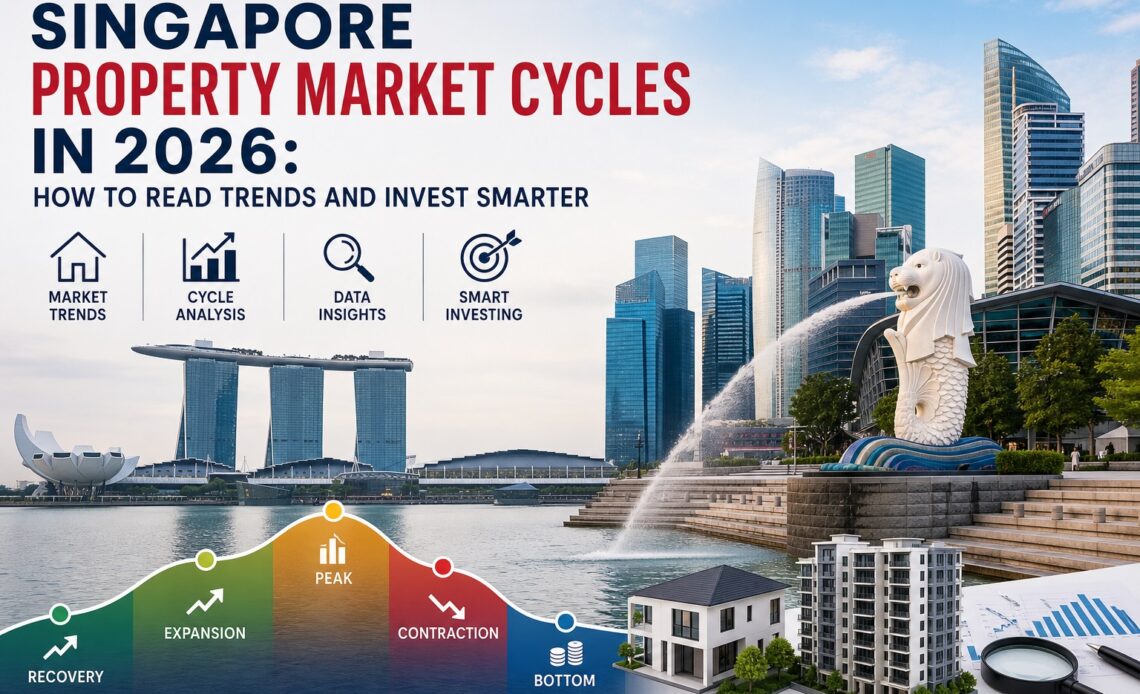
While simplified, Singapore’s property market generally moves through four phases:
1. Recovery Phase
This occurs after a period of cooling or slower demand. Prices stabilize, and transaction volume begins to rise gradually. Early investors often enter during this phase.
2. Expansion Phase
Demand increases due to strong economic conditions and improved sentiment. New launches perform well, and prices begin to rise steadily.
3. Peak Phase
Buyer demand remains strong, but price growth slows as affordability limits are reached. Government cooling measures are often introduced or tightened during this stage.
4. Correction Phase
Market activity slows, prices stabilize or dip slightly, and buyers become more cautious. This phase often presents opportunities for long-term investors.
Understanding where the market currently sits in this cycle helps investors make more rational decisions.
How Government Policy Shapes Every Cycle
Unlike many markets, Singapore’s property cycle is heavily influenced by policy intervention. Authorities actively manage demand to prevent overheating and ensure long-term affordability.
Key policy tools include:
- Additional Buyer’s Stamp Duty (ABSD)
- Loan-to-Value (LTV) limits
- Seller’s Stamp Duty (SSD)
- Tightened lending regulations
These measures prevent excessive speculation and reduce the risk of sharp market crashes, but they also extend cycle durations.
Infrastructure as a Cycle Accelerator
Infrastructure development plays a major role in shaping property demand cycles. When new MRT lines, business districts, or lifestyle hubs are announced, surrounding property values often begin to rise even before completion.
This forward-looking pricing behavior is common in Singapore. Investors often anticipate future improvements rather than reacting to current conditions.
For example, developments such as Lucerne Grand benefit from long-term planning effects where connectivity and surrounding infrastructure contribute to gradual value appreciation.
Emotional vs Rational Buying Behavior
One of the biggest challenges in property investment is managing emotional decision-making. During expansion phases, buyers may rush in due to fear of missing out. During correction phases, they may hesitate even when opportunities exist.
Successful investors focus on fundamentals rather than sentiment:
- Location strength
- Rental demand stability
- Long-term infrastructure plans
- Entry price relative to historical trends
This disciplined approach helps avoid buying at peaks or selling during downturns.
The Role of Rental Demand Across Cycles
Rental demand in Singapore remains relatively stable across cycles due to consistent expatriate inflows and a strong professional workforce.
However, rental yields can fluctuate depending on supply conditions and buyer sentiment. During periods of high new supply, rental competition increases. During tighter supply phases, landlords may achieve stronger yields.
Properties with strong connectivity and lifestyle appeal tend to perform consistently well across all phases.
Developments like Island Residences often attract tenants seeking a quieter, more balanced living environment while still maintaining accessibility to key employment hubs.
Identifying Cycle Opportunities
Each phase of the property cycle presents different opportunities:
Recovery Phase Opportunities
- Early entry into new launches
- Undervalued resale properties
- Emerging districts with infrastructure plans
Expansion Phase Opportunities
- Capital appreciation through rising demand
- Strong resale market liquidity
- Healthy rental demand growth
Peak Phase Strategy
- Selective buying only in strong locations
- Focus on rental yield stability
- Avoid over-leveraging
Correction Phase Opportunities
- Bargain entry points
- Negotiation advantages in resale market
- Long-term investment positioning
Why Timing Matters Less Than Quality
While understanding cycles is useful, Singapore’s market structure means that asset quality often matters more than timing.
A well-located, high-quality property tends to recover and appreciate over time regardless of short-term fluctuations. Poorly located or oversupplied properties may underperform even during strong market phases.
This is why experienced investors prioritize fundamentals over timing attempts.
The Impact of Interest Rate Cycles
Interest rates are another layer influencing property cycles. Higher rates generally reduce affordability and slow demand, while lower rates stimulate buying activity.
In 2026, many investors are still adjusting to a higher-rate environment compared to the previous decade. This has encouraged more conservative borrowing and greater focus on cash flow stability.
Long-Term Cycle Outlook
Singapore’s property market is expected to remain in a controlled growth pattern rather than extreme boom-bust cycles. This makes it more predictable but also requires patience from investors.
Long-term drivers include:
- Population growth and immigration policy
- Continued urban redevelopment
- Limited land supply
- Strong economic fundamentals
These factors ensure that demand remains structurally supported over time.
Conclusion
Understanding property cycles in Singapore is less about predicting exact peaks and bottoms and more about recognizing broader patterns shaped by policy, infrastructure, and demand stability.
Investors who focus on fundamentals, maintain discipline across cycles, and avoid emotional decision-making are more likely to achieve consistent long-term results.
Whether evaluating emerging opportunities like Lucerne Grand or lifestyle-oriented developments such as Island Residences, success ultimately depends on aligning investment choices with the structural direction of Singapore’s property market.