
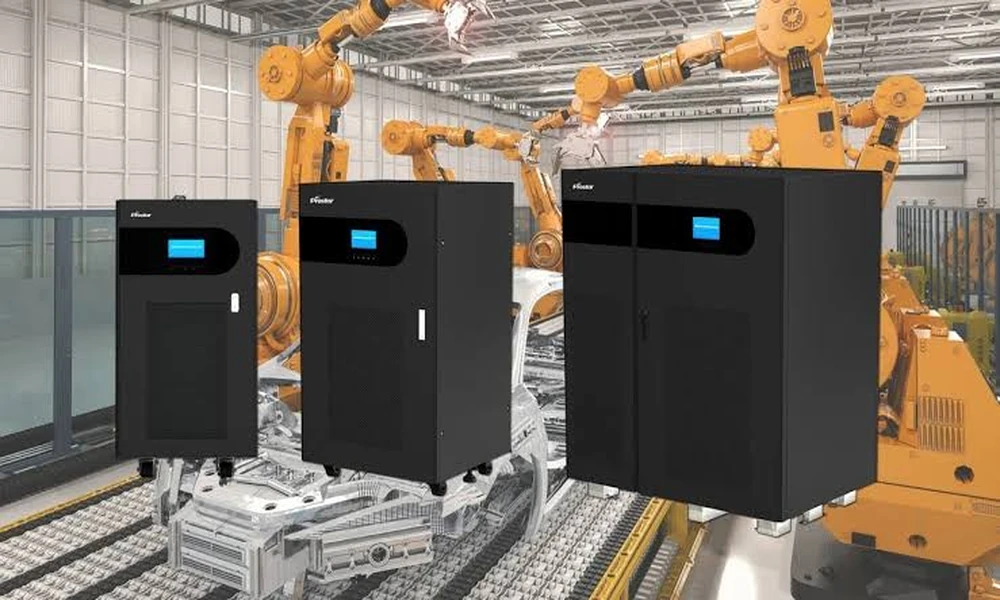
In 2026, the industrial landscape in Thailand is rapidly moving towards full automation and smart manufacturing. With advanced AI-driven machinery and IoT systems operating around the clock, even a millisecond of power fluctuation can result in catastrophic financial losses and data corruption. Securing an uninterrupted power supply is no longer optional; it is a critical operational foundation.
When selecting a high-capacity UPS large manufacturing plant systems must be evaluated based on efficiency, scalability, and battery technology. For modern facilities looking to future-proof their operations, finding the right industrial-grade solution-often referred to as an uninterruptible power supply for industrial scale (known in Thai as “UPS โรงงานขนาดใหญ่“)-is vital to maintaining continuous production. Investing in premium power protection safeguards sophisticated machinery, reduces maintenance overhead, and ensures that factory workflows remain resilient against unpredictable grid instabilities.
Evaluate Total Power Load
Choosing the right power protection begins with a precise calculation of your total electrical load. A standard system will fail under industrial stress, which is why a robust UPS large manufacturing plant requires a capacity that accounts for both continuous operational load and high inrush currents from heavy machinery.
Overloading a system can lead to immediate shutdown during a power outage, defeating its purpose. Engineers must audit all critical assets-such as assembly lines, automated robotics, and server rooms-to determine the minimum kVA or kW rating needed to sustain seamless operations during grid transitions.
Prioritize Lithium-ion Battery Technology
In 2026, traditional Lead-Acid batteries are being replaced by Lithium-ion (LiFePO4) technology due to its superior lifespan and thermal resilience. For any UPS large manufacturing plant systems operating in tropical climates like Thailand must withstand high ambient temperatures without degrading. Lithium-ion batteries offer up to three times the operational lifespan and a significantly smaller physical footprint.
This drastically reduces the Total Cost of Ownership (TCO) by minimizing frequent battery replacements and lowering cooling costs in power rooms, making it a highly sustainable and economically viable choice for modern industries.
Opt for Modular Scalability
Industrial facilities are rarely static; they grow alongside market demands. Therefore, selecting a system with a modular architecture is essential for long-term scalability. A modular UPS large manufacturing plant allows operators to add power modules incrementally as factory capacity expands, avoiding massive upfront capital expenditures.
Furthermore, modular systems feature hot-swappable components, meaning maintenance teams can replace or upgrade modules without shutting down the entire system. This ensures absolute zero-downtime operations, keeping the production line running continuously during servicing or capacity expansions.
Assess Double-Conversion Online Topology
Protection quality depends heavily on internal architecture. For sensitive electronics, a Double-Conversion Online UPS is the absolute standard. This topology ensures that incoming AC power is converted to DC, and then back to a clean, stable AC sine wave.
When configuring a UPS large manufacturing plant, this design guarantees zero transfer time during a power failure. Sensitive equipment like programmable logic controllers (PLCs) and CNC machines are highly vulnerable to voltage sags and surges; online double-conversion completely isolates them from raw grid anomalies, preventing costly production micro-stops.
Verify Smart Remote Monitoring
Modern industrial operations rely on real-time data to prevent unexpected failures. A cutting-edge UPS large manufacturing plant system must feature advanced smart monitoring and IoT connectivity. This allows facility managers to track battery health, load levels, and temperature fluctuations remotely via a centralized dashboard.
With predictive analytics, the system can alert maintenance teams to potential issues before an actual hardware failure occurs. Integrating smart diagnostic tools ensures proactive management, significantly reducing emergency downtime and extending the overall operational life of your facility’s entire critical power infrastructure.
Selecting the ideal power backup solution requires a strategic balance of high load capacity, cutting-edge battery technology, and smart monitoring capabilities. As industries in 2026 demand absolute operational continuity, compromises on power infrastructure are no longer viable. Chuphotic, a trusted leader in power protection solutions, addresses these industrial challenges perfectly with their Venus Ultimate Plus-Li series. Designed explicitly to meet the demanding environment of a modern UPS large manufacturing plant, Chuphotic integrates advanced Lithium-ion battery systems with exceptional double-conversion efficiency. By choosing Chuphotic, manufacturers secure a highly reliable, scalable, and cost-effective power safeguarding partner that guarantees continuous uptime. Protect your heavy investments, optimize your energy efficiency, and empower your smart production lines to run flawlessly by integrating Chuphotic‘s premier uninterruptible power technologies into your factory infrastructure today.