
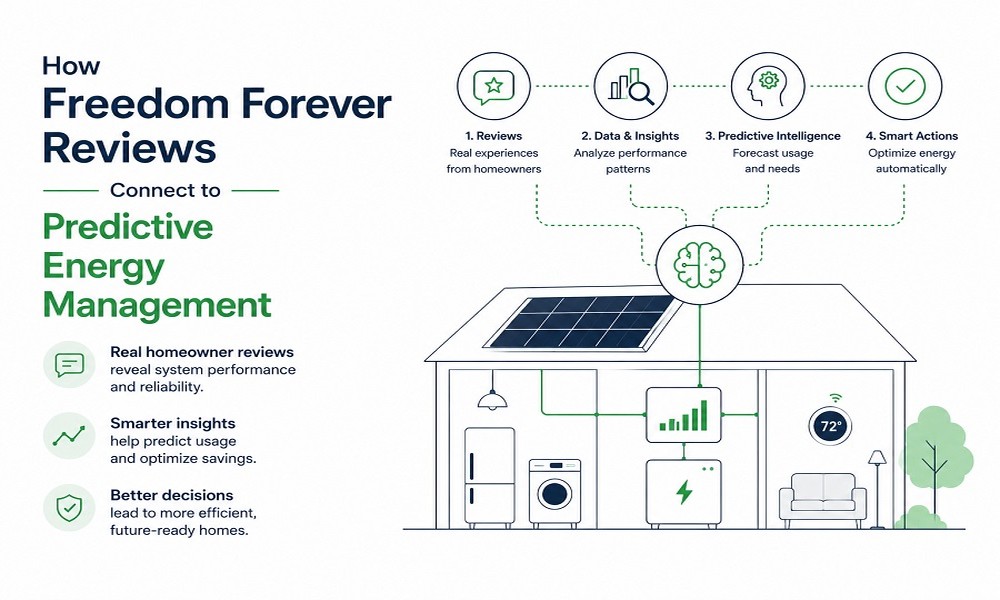
Reliability has become a central concern in modern energy households as solar and smart technology reshape how homes access power. Rather than relying solely on real-time adjustments, many systems now anticipate future conditions to stabilize daily availability. Freedom Forever Reviews reflect a market where solar systems are often paired with monitoring tools and digital dashboards that provide greater visibility into production and usage.
Homeowners want confidence that power can remain available for daily needs without constant monitoring. Predictive management supports this expectation by forecasting how energy flows through the home, allowing systems to prepare for likely conditions before disruptions occur.
Predictive Management Builds on Historical Patterns
Predictive energy management relies on historical data to inform future behavior. Systems analyze past production levels, usage trends, and environmental conditions to establish baseline expectations. These patterns provide context for anticipating what a typical day may require.
By referencing history, systems move beyond immediate reaction. Forecasting allows homes to prepare for expected demand rather than adjusting only after changes occur. This foundation supports smoother operation and reduces surprises tied to daily variability.
Forecasting Production Supports Planning
Solar production varies based on weather, daylight, and seasonal conditions. Predictive systems incorporate forecasting models that estimate upcoming output. These projections allow homes to plan energy use around expected availability.
When production forecasts indicate lower output, systems adjust priorities in advance. Homes draw on stored energy or shift discretionary use earlier. Forecasting turns uncertainty into manageable planning rather than a last-minute response.
Anticipating Demand Stabilizes Availability
Demand forecasting complements production estimates by anticipating household energy needs. Predictive systems analyze routines to estimate when usage can rise or fall. These forecasts reflect daily rhythms such as mornings, evenings, and weekends. Seasonal shifts and special events are also factored into demand expectations. This broader context helps systems prepare for variability without overestimating needs. As accuracy improves, energy planning becomes more aligned with real household behavior.
By anticipating demand, systems allocate resources more effectively. Energy remains available for essential needs even during peak periods. Demand forecasting supports stability by aligning preparation with expected activity.
Storage Plays a Key Predictive Role
Battery storage enhances predictive management by acting as a buffer between forecasts and reality. Stored energy allows systems to respond when actual conditions differ slightly from predictions. Storage absorbs variability without disrupting availability.
Predictive systems manage storage proactively. Charging and discharge decisions reflect anticipated conditions rather than immediate necessity. This strategy supports consistent access to power across changing circumstances. Storage capacity is allocated with future demand in mind. Systems balance readiness with efficiency to avoid unnecessary cycling. Over time, proactive storage management enhances reliability and prolongs battery life.
Automation Executes Predictive Decisions
Automation translates forecasts into action. Predictive insights guide automated adjustments across appliances, climate systems, and charging schedules. These actions occur without homeowner intervention. Execution happens through coordination rather than isolation. Systems prioritize changes that deliver the greatest overall benefit. As a result, forecasts translate into practical, measurable outcomes.
Predictive planning remains seamless in daily life. Homes maintain comfort while systems adjust quietly in anticipation of demand. Reliability improves as preparation occurs before stress points emerge.
Everyday Reliability Reduces Cognitive Load
Predictive energy management reduces the need for constant attention. Homeowners do not need to monitor forecasts themselves. Systems handle preparation in the background. Automation absorbs complexity without shifting responsibility to the homeowner. Adjustments occur quietly as conditions evolve. This hands-off reliability allows energy planning to remain effective without becoming a daily task.
This reduction in cognitive load supports trust. Households rely on systems to manage variability without active involvement. Reliability becomes a default experience rather than an ongoing concern.
Visibility Reinforces Confidence in Prediction
Visibility supports predictive management by showing how forecasts translate into action. Dashboards display anticipated production and usage alongside actual outcomes. This transparency helps homeowners understand system behavior.
When predictions align closely with results, confidence grows. Visibility reinforces trust by connecting preparation with performance. Homeowners see reliability because of planning rather than chance. This consistency strengthens belief in the system’s underlying logic. Over time, observed accuracy reduces skepticism and second-guessing. Trust becomes grounded in repeatable outcomes rather than isolated successes.
Customer Feedback Reflects Reliability Over Time
Homeowner feedback consistently highlights reliability as systems mature and performance becomes more predictable. As predictive management refines forecasting and resource allocation, daily energy availability feels increasingly steady and dependable. Online discussions, including Freedom Forever reviews, often reflect confidence in consistent, day-to-day system performance, emphasizing trust in how energy is managed and delivered over time.
These patterns show that reliability strengthens through lived experience. Reviews frequently express appreciation for systems that manage variability smoothly and efficiently. Predictive performance supports satisfaction by delivering a stable, responsive operation that homeowners can rely on with confidence.
Predictive Systems Handle Variability Gracefully
No forecast is perfect, but predictive systems manage deviation effectively. When conditions change unexpectedly, systems adjust within prepared ranges. Variability remains manageable rather than disruptive. Bounded flexibility helps absorb short-term fluctuations without compromising performance. Systems prioritize stability while adapting to real-world uncertainty. This balance supports confidence in predictive energy management despite inevitable change.
This grace under uncertainty supports reliability. Homes continue operating smoothly even when predictions shift slightly. Predictive management balances preparation with flexibility.
Planning Horizons Extend Beyond the Day
Predictive energy management supports planning beyond daily cycles. Systems consider seasonal trends and longer-term patterns. This broader perspective supports decisions tied to storage sizing, automation settings, and future upgrades. Forecasting allows households to prepare rather than react to change. Long-term data helps align system capacity with anticipated needs. As a result, energy planning becomes more deliberate and resilient over time.
Households benefit from stability that extends across months. Predictive planning informs long-term confidence rather than addressing isolated events. Reliability becomes part of ongoing household planning.
The Future for Solar-Powered Homes
As predictive management becomes more common, expectations around reliability change. Solar-powered homes rely less on immediate reaction and more on preparation. Prediction replaces guesswork as a foundation for stability.
Forecasting accuracy and system integration increasingly shape the performance of modern residential energy systems. Predictive energy management strengthens reliability when preparation aligns closely with real-world conditions. As households prioritize dependable daily access and consistent performance, predictive systems help define the next phase of residential energy management, where anticipation, coordination, and responsiveness work together to support lasting stability.